meridsource White Logo

How to Manage SKU Growth Without Creating Supply Chain Complexity

Adding a new product can create new opportunities for a growing bag brand.

  • A new backpack.
  • A new color.
  • A new collection.

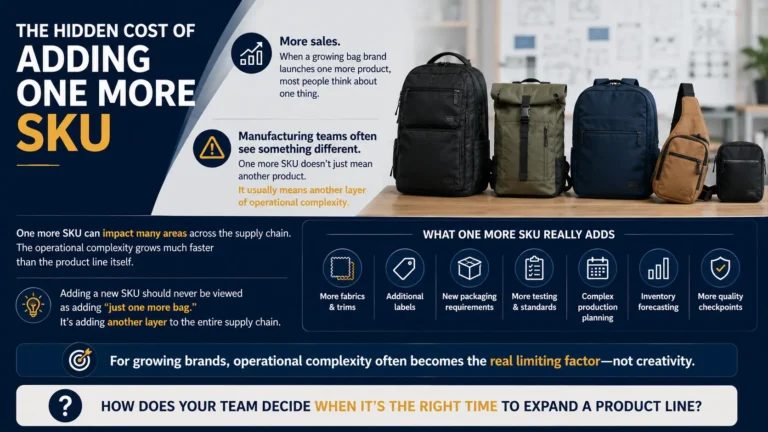
But every new SKU also adds another layer of operational requirements.

Many brands focus on the sales potential of a new product while underestimating the complexity behind it.

A new SKU is not only another design.

It can require:

  • New materials.
  • Different trims and hardware.
  • Updated labels and packaging.
  • Additional testing requirements.
  • New production planning.
  • More inventory management.
  • Extra quality control checkpoints.

The challenge is not adding products.

The challenge is building systems that can support product growth.

1. Understand the Real Cost of a New SKU

Before launching a new product, brands should evaluate the complete impact on operations.

A new SKU may affect:

  • Supplier coordination.
  • Material sourcing.
  • Production schedules.
  • Quality management.
  • Inventory planning.

Understanding these requirements helps brands make better decisions before expanding their product line.

2. Create a Clear Role for Every Product

Successful brands do not add products only because they can.

Each SKU should have a clear purpose:

  • A core product that drives sales.
  • A seasonal product that creates new opportunities.
  • A testing product for market feedback.
  • A premium product that strengthens brand positioning.

A clear product structure helps prevent unnecessary complexity.

3. Build Systems Before Scaling Products

As product lines grow, manual management becomes harder.

Brands need stronger systems for:

  • Product documentation.
  • Supplier communication.
  • Quality standards.
  • Inventory forecasting.
  • Production planning.

The goal is not to avoid adding products.

The goal is to make sure the business can support them.

4. Balance Product Expansion With Operational Capability

Product growth should happen together with supply chain development.

A successful product line is not only measured by how many SKUs a brand launches.

It depends on whether the company can consistently manage those products from development to delivery.
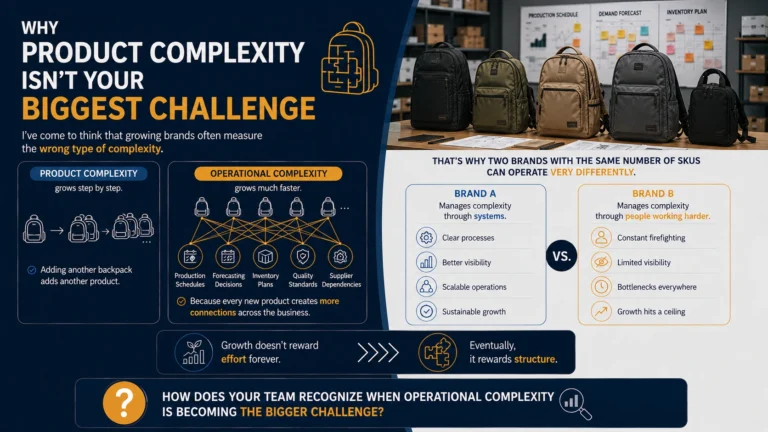
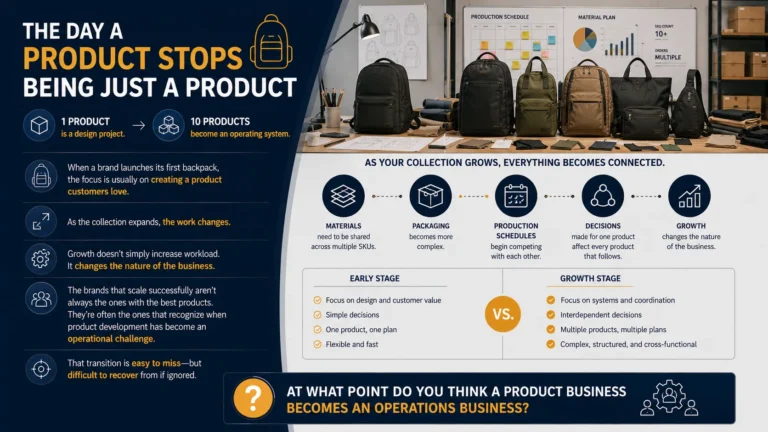
Adding one more SKU is never just adding one more bag.

It is adding another layer of responsibility across the entire supply chain.

For growing brands, managing complexity is often the key to sustainable product expansion.

Latest knowledge

FAQs

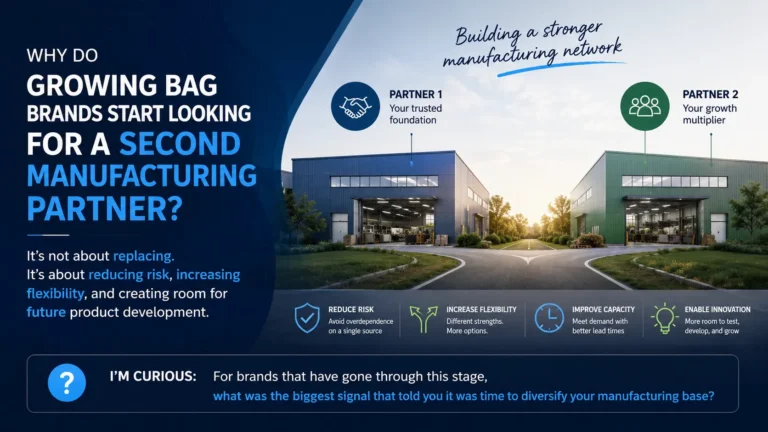
A brand should evaluate a second manufacturer when it can identify a specific capacity, capability, concentration, lead-time, or geographic constraint. The decision should be supported by a clear product allocation model and controlled requirements. A general desire for “more options” is not enough. First confirm that the real problem is not late planning, changing specifications, weak forecasting, or unclear internal ownership.

No. Dual sourcing can reduce dependence on one production route, but it also creates more coordination, qualification, documentation, material, and quality-control work. Two factories may still depend on the same upstream supplier. Risk falls only when the second route is genuinely qualified, addresses the relevant dependency, and can be managed without creating larger execution problems.

Sometimes, but only when the business exposure justifies planned dual sourcing. Both factories need controlled specifications, approved materials, patterns, tooling rules, quality criteria, and comparable production evidence. For many brands, a capability split is simpler: each factory owns a different product family. The correct model depends on the risk, volume, and management capacity.

Start with a controlled pilot SKU that tests the capability the brand actually needs. Review similar-product evidence, technical communication, material control, sampling, pre-production preparation, inline quality, final inspection, packaging, and delivery. Then place a limited pilot order. Do not qualify a production partner from a showroom, quotation, audit, or single sample alone.

Use one controlled product standard. It should include the tech pack, BOM, approved material and color references, construction details, tolerances, tests, packaging, approved sample, and inspection criteria. Use the same change-control and corrective-action process for both factories. Even with these controls, compare real production output because different equipment, materials, and workmanship can still create variation.

The reaction often depends on how the change is managed. Explain the business reason, protect confidential information, and keep allocation criteria stable. Do not frame a strategic network decision as punishment when the supplier has performed well. If the current factory continues to receive meaningful, well-planned business, the relationship can remain strong while the brand adds another capability or continuity route.

Often, it is not. Dividing limited volume can reduce leverage and attention at both factories. A qualified backup for one selected product may be more practical than two active sources for every SKU. Before adding a factory, compare the value of diversification with the extra development, MOQ, material, quality, travel, and management cost.