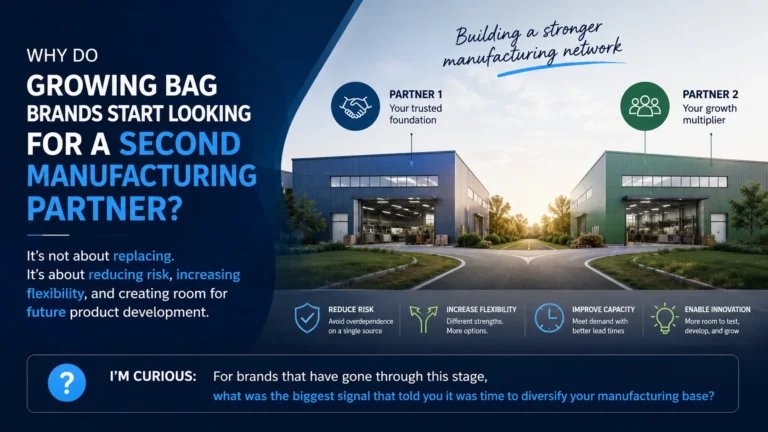
Why Do Growing Bag Brands Start Looking for a Second Manufacturing Partner?
Most bag brands begin with one trusted manufacturing partner. This is often the right decision. Communication is direct. Product development is faster. Quality responsibility is clear. Order volume is not divided across several factories.
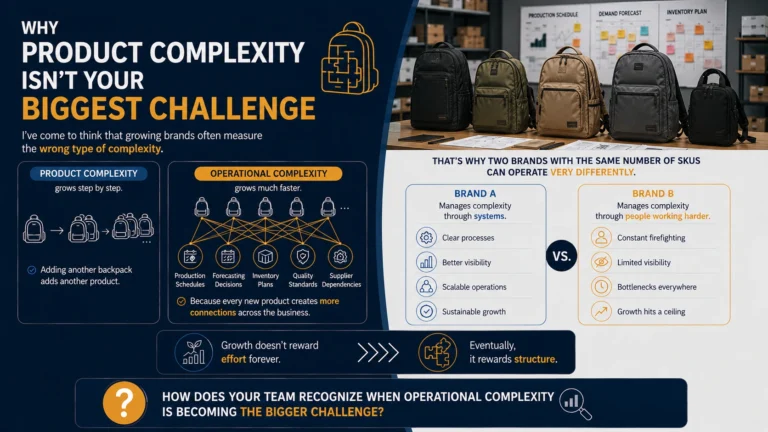
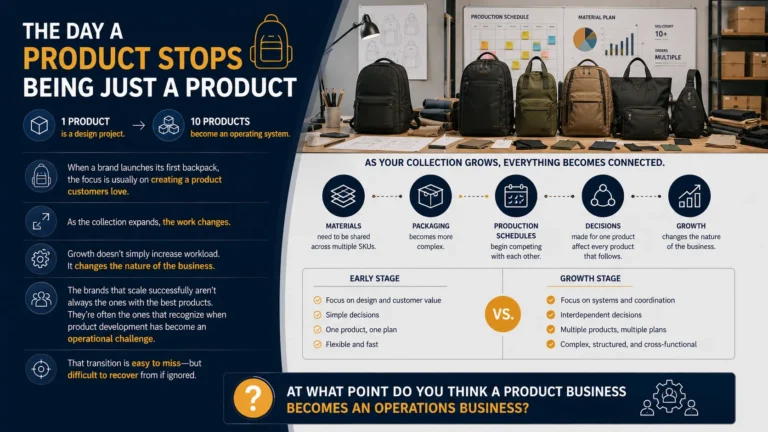
Then the business changes. The brand adds products, materials, colorways, launch dates, and quality requirements. The question is no longer only, “Is this a good factory?” It becomes, “Can this manufacturing network support the next stage of growth?”
Direct Answer
Growing bag brands usually evaluate a second manufacturing partner when one factory no longer provides the right mix of capacity, capability, lead-time flexibility, and risk coverage. The goal is not necessarily to replace a good supplier. It is to solve a defined constraint. However, a second partner only adds value when the brand can manage shared specifications, quality standards, product allocation, and communication across both factories.
Why One Manufacturing Partner Often Works at the Beginning
Single sourcing is not automatically a weakness. For a young brand, it can be the simplest and most efficient operating model.
The factory learns the product, the founder’s preferences, and the brand’s quality expectations. Each sample round creates shared knowledge. Problems can be discussed through one communication path. There is one main team responsible for materials, construction, production, and correction.
Concentrating volume can also matter. A smaller brand may not have enough orders to support two healthy relationships. Dividing limited volume can weaken its position with both factories. Each supplier receives less repeat business, less forecast visibility, and less reason to reserve development or production resources.
One partner is especially effective when the product range is focused. A factory that performs well on a stable family of backpacks may support the brand for years. The model becomes less suitable only when the business changes faster than the relationship can adapt.
What Changes as a Bag Brand Grows
Growth increases more than unit volume.
A brand may add soft luggage, structured travel bags, technical backpacks, totes, or accessories. Each category can require different machines, construction knowledge, material suppliers, testing, packaging, and quality controls. Even within one category, new fabric systems, molded parts, waterproof details, or hardware can change the manufacturing process.
The planning calendar also becomes more complex. Core products may need regular replenishment. Seasonal products have fixed launch dates. Experimental products need small, controlled tests. One factory may be strong in one of these patterns but weak in another.
The risk also changes. When a brand has only a few products, one delayed order may be painful but manageable. When a large share of sales depends on the same production route, a delay can affect several launches, markets, or replenishment cycles at once.
The OECD Supply Chain Resilience Review explains that concentrated supply can increase exposure to disruption. It also makes an important counterpoint: diversification has costs and does not automatically create resilience. For a bag brand, this means a second factory should solve a defined problem. It should not be added only because diversification sounds safer.
Seven Signals That It May Be Time to Evaluate a Second Partner
No single signal creates an automatic decision. The value comes from seeing several signals together and checking whether the root cause is really the factory network.
1. Capacity Is Regularly Tight During Critical Production Windows
What it looks like: The current factory performs well during normal periods but repeatedly struggles to reserve lines, workers, or finishing capacity before important launch or replenishment dates.
What it may mean: The brand’s calendar and the factory’s capacity model may no longer fit. A second partner could give selected products another qualified production route.
Check before adding a factory: Confirm whether the problem comes from late purchase orders, changing forecasts, slow approvals, or incomplete material booking. Another factory will not fix planning that starts too late.
2. New Products Need Capabilities Outside the Current Factory's Strengths
What it looks like: The brand moves from simple sewn bags into structured luggage, molded components, waterproof construction, technical frames, leather work, or another process the current partner rarely handles.
What it may mean: The brand has a capability gap, not only a capacity gap. A specialist partner may produce the new category more reliably than asking the first factory to learn every process.
Check before adding a factory: Define the new product correctly. Separate essential capabilities from features that are still changing. A vague concept makes every supplier assessment unreliable.
3. One Delay Can Affect Too Much of the Launch Calendar
What it looks like: Several important products, markets, or replenishment orders depend on the same factory, material route, or production schedule.
What it may mean: The brand has concentration exposure. A qualified second route may reduce the effect of one operational failure.
Check before adding a factory: Map the full dependency. Two sewing factories may still rely on the same fabric mill, zipper source, mold, or packaging supplier. A second factory does not create real diversification if the critical upstream dependency remains unchanged.
4. Lead-Time Needs Differ Across the Product Portfolio
What it looks like: Core products need stable replenishment, seasonal launches need fixed delivery windows, and test products need flexible development. The same factory must keep changing priorities.
What it may mean: The portfolio may need different production models. One partner could focus on repeat programs while another handles development-heavy or seasonal work.
Check before adding a factory: Classify the portfolio first. If the brand cannot define which products are core, seasonal, or experimental, a second factory may increase scheduling conflict instead of reducing it.
5. Cost Comparisons Are No Longer Like for Like
What it looks like: Quotations are difficult to compare because materials, construction details, testing, packaging, tolerances, or quality assumptions are not fully aligned.
What it may mean: The brand needs a controlled benchmark. A second qualified factory can help test whether a cost difference comes from efficiency, capability, material choice, or a different interpretation of the product.
Check before adding a factory: Normalize the request for quotation. Both factories must price the same tech pack, BOM, material references, packaging, testing, Incoterm, and quality requirements. Otherwise, the lower quote may simply represent a different product.
6. The Brand Needs a Different Country, Cluster, or Supply-Chain Route
What it looks like: A market, customer, duty position, material source, logistics plan, or continuity objective creates a reason to evaluate another production location.
What it may mean: Geography may become part of the manufacturing strategy. A second route can create options when it fits the product and commercial model.
Check before adding a factory: Calculate the complete landed and operating cost. Include product cost, tooling, development travel, testing, duty, freight, inventory, communication, quality control, and transition risk. Country labels alone do not prove better cost or lower risk.
7. The Future Portfolio Is Changing Faster Than the Current Network
What it looks like: The current partner still performs well, but the next product roadmap needs faster learning, different suppliers, new materials, or more development support than the existing model can provide.
What it may mean: The brand may need to expand before a failure occurs. This is a strategic capacity and capability decision, not a reaction to poor performance.
Check before adding a factory: Compare the future portfolio with the current partner’s development plan. The existing factory may be able to invest, train, or build the required capability. A second source is only one option.
What a Second Partner Can and Cannot Solve
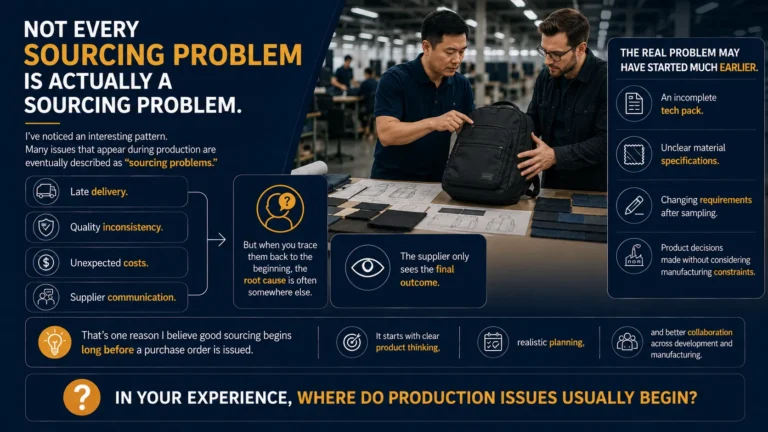
The fastest way to make a poor decision is to treat every sourcing problem as a supplier-number problem.
| A second partner can help with | A second partner cannot fix by itself |
|---|---|
| Reduce dependence on one production route | Complete an unclear tech pack |
| Fill a defined construction or category capability gap | Create quality standards the brand has not defined |
| Add planned capacity flexibility | Stabilize requirements that keep changing |
| Give different product families to specialists | Correct an unrealistic sales forecast |
| Support a justified geographic or trade-route option | Control materials without approved references and ownership |
| Create a controlled benchmark for cost and execution | Replace weak internal decision-making |
The OECD procurement resilience toolkit notes that multiple suppliers can add flexibility and support performance comparison. That principle is useful, but the toolkit does not say that a second source is free. A brand must manage more development, more records, more relationships, and more opportunities for variation.
Three Practical Manufacturing-Network Models
The correct model depends on the reason for adding a partner. A brand should choose the model before it starts sending random requests for quotation.
Model 1: Primary Partner Plus Qualified Backup
Best fit: A brand wants continuity for selected products but still benefits from one main relationship.
Main benefit: The brand keeps most volume and shared learning with the primary partner while developing another qualified route.
Main operating cost: The backup must remain current. Samples, materials, tooling, documents, and compliance records can become outdated if no real work is placed.
Main failure mode: The “backup” exists only in a spreadsheet. It has not completed recent sampling, material validation, or a production cycle.
Model 2: Capability Split
Best fit: Product families need different construction, materials, machines, or production systems.
Main benefit: Each partner works within a defined area of strength. A technical backpack factory does not need to become a luggage-shell specialist, and the luggage specialist does not need to learn every soft-bag process.
Main operating cost: The brand must manage different supplier systems while keeping common requirements, brand standards, and reporting rules.
Main failure mode: Product ownership becomes unclear. Similar products move between suppliers without a defined reason, creating duplicated development and inconsistent standards.
Model 3: Planned Dual Source
Best fit: The same or a closely related product needs two active production routes because business exposure justifies the added control work.
Main benefit: The brand can allocate production using current performance, capacity, location, or continuity needs.
Main operating cost: Both factories need controlled specifications, equivalent materials, approved samples, tooling rules, and comparable inspection data.
Main failure mode: The brand assumes the same tech pack will automatically create the same product. Small differences in materials, machines, patterns, tolerances, and workmanship can produce two versions of the bag.
None of these models requires an equal split. Allocation should follow the business reason, available volume, qualification status, and measured performance.
Is the Brand Ready to Manage Two Partners?
Adding a factory is easier than managing a manufacturing network. The following scorecard is a discussion tool. It is not a scientific model and does not predict success.
Score each dimension from 0 to 2:
- 0: Not established.
- 1: Partly established.
- 2: Established and documented.
| Dimension | 0 — Not established | 1 — Partly established | 2 — Established and documented |
|---|---|---|---|
| Business exposure | The risk or constraint is not defined | The concern is visible but not measured | The affected products, dates, revenue exposure, or customer impact are mapped |
| Capability fit | The factory search is general | Required capabilities are partly listed | Product-specific capability requirements and evidence are defined |
| Product-definition readiness | Requirements change through messages | A tech pack exists but important references are missing | Tech pack, BOM, materials, tolerances, packaging, tests, and approved sample are controlled |
| Quality-system readiness | Quality depends on personal judgment | Inspection points exist but differ by supplier | Common acceptance criteria, records, escalation, and corrective-action rules are documented |
| Internal coordination capacity | No clear owner exists | One person coordinates informally | Ownership, approvals, allocation, changes, and supplier communication are defined |
Total score = Business exposure + Capability fit + Product-definition readiness + Quality-system readiness + Internal coordination capacity.
The maximum score is 10 because there are five dimensions and each dimension has a maximum of 2: 5 × 2 = 10.
Do not use the total as an automatic pass or fail. A high total cannot correct a critical zero. For example, strong business exposure does not make dual sourcing practical when product requirements are still uncontrolled. Review each dimension and identify the weakest condition.
A Phased Plan for Adding a Second Manufacturing Partner
1. Define the Business Reason
Write one clear problem statement. Examples include a category capability gap, repeated capacity conflict, excessive concentration, a justified geographic requirement, or the need for another active production route.
If the reason cannot be stated without using broad words such as “more flexibility,” the project is not ready. Define what must become more flexible, for which products, and under which conditions.
2. Choose the Network Model
Decide whether the new partner will be a qualified backup, own a different capability, or become an active dual source. This choice affects supplier selection, tooling, sampling, data, and allocation.
3. Select a Controlled Pilot SKU
Choose a product that can test the required capability without placing the entire program at risk. The pilot should be commercially meaningful, but its failure should be containable.
Avoid choosing the easiest bag if it does not test the real reason for adding the factory. Also avoid beginning with the most important launch.
4. Normalize the Product Standard
Create one controlled source of truth. It should include the tech pack, BOM, approved material references, color standards, construction details, measurement tolerances, test requirements, packaging, labeling, approved sample, and inspection criteria.
The ISO guidance on documented information explains that organizations should maintain information needed to support process operation and retain evidence that work was carried out as planned. In a bag program, clear specifications and controlled samples help both factories work from the same requirement. They do not guarantee identical output, but they reduce avoidable interpretation.
5. Evaluate Capability Before Price
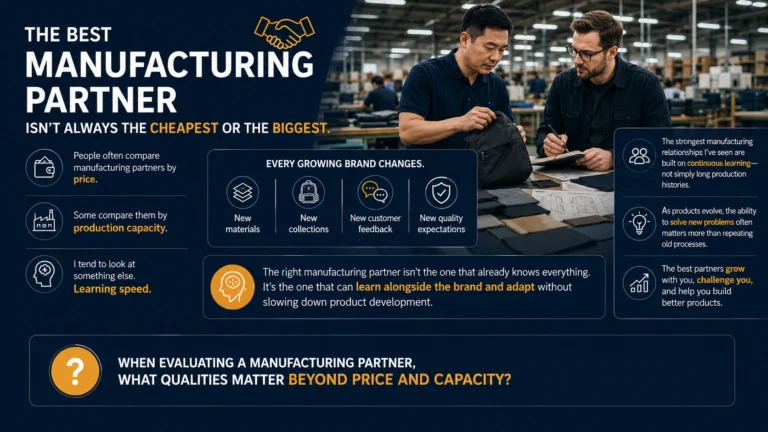
Ask for product-specific evidence. Review similar constructions, materials, machines, engineering support, quality records, subcontracting, capacity planning, and the people who will manage the program.
Supplier checks should match the actual requirement. The UK Government Procurement Pathway describes due diligence as proportionate and tailored to the specific purchase. The same principle applies here: a factory should be tested against the pilot product, not a generic factory checklist.
6. Run Sampling and Pre-Production Validation
Use sampling to test how the factory reads information, raises questions, controls materials, explains limits, and responds to corrections. Do not judge only the final appearance.
Before production, confirm the BOM, material sources, patterns, tooling, construction, workmanship standard, test plan, packaging, inspection method, and approval authority.
7. Place a Limited Pilot Order
The first order should test the complete operating system: material booking, pre-production control, inline quality, final inspection, packaging, documents, and delivery.
“Limited” does not mean using a universal number. The size should be large enough to expose repeatability and production control, but small enough to contain commercial risk. The right quantity depends on product cost, MOQ, market need, and the factory’s real production method.
8. Compare Execution on the Same Scorecard
Compare what both partners were asked to do and what they actually delivered. Use the same measures for sample accuracy, response quality, material control, production readiness, quality findings, corrective action, delivery, and cost changes.
Do not use the first factory’s confidential quote, pattern, or process knowledge as free development material for the second.
9. Set Allocation, Escalation, and Ownership Rules
Define which products each factory can receive, who approves transfers, how forecast and capacity information is shared, who controls master documents, and how quality or delivery problems are escalated.
Allocation should follow the network model. It should not change every time one quote is slightly lower.
10. Review the Network After One Complete Production Cycle
Review the result after development, material booking, production, inspection, shipment, and post-delivery feedback. A supplier that produces one good sample is not yet a proven production partner.
Continue assurance after selection. Official GOV.UK supply-chain assurance guidance recommends repeated checks, verification where possible, record keeping, and action based on findings. The guidance has a different sector focus, but the general control principle is sound.
How to Add a Second Partner Without Damaging the First Relationship
Adding a supplier does not need to become a threat.
Start with the business reason. If the first factory is performing well, say so. Explain whether the new partner supports another category, location, capacity window, or continuity need. Do not create a false performance complaint to justify a strategic decision.
Protect confidential information. Do not send one factory’s quotation, pattern, production method, or internal problem-solving record to the other without permission. Competition should be based on a common brand requirement, not the transfer of supplier knowledge.
Keep allocation criteria clear. The first partner should understand how performance, capability, capacity, product family, and business continuity affect decisions. Constantly moving orders to chase small price differences damages planning and trust.
Preserve meaningful business when performance remains strong. A long-term partner cannot reserve people, materials, or capacity if the brand offers only uncertainty.
Most importantly, maintain one product standard. The brand owns the requirement. Each factory should receive controlled documents, approved references, and clear change notices. Supplier relationships can be separate, but the product definition should not be.
When One Manufacturing Partner Is Still the Better Choice
A second factory is not a maturity badge. One partner may remain the better model when:
- The product range is narrow, stable, and within the current factory’s strengths.
- The current partner has suitable capability and realistic capacity.
- Total order volume is too limited to support two committed relationships.
- Product documentation is not ready for consistent interpretation.
- The internal team cannot manage duplicated development, material, and quality work.
- The proposed second partner does not solve a defined business risk or capability gap.
In these conditions, the better investment may be stronger forecasting, clearer tech packs, material control, quality standards, or a development plan with the current factory.
A Simple Final Decision Rule
Add a second partner when it solves a defined constraint and the brand is ready to manage a network. Do not add one simply because growth makes diversification sound safer.
The strongest decision is not “one factory” or “two factories.” It is a manufacturing model that matches the product portfolio, business exposure, and management capacity of the brand.
If you need an independent second view, MeridSource can help screen a potential manufacturing partner or review the tech pack before product, cost, and quality assumptions are locked into the purchase order.
Sources and Method
External facts in this article use primary or authoritative sources accessed on July 17, 2026. The decision signals, scorecard, and implementation sequence are MeridSource professional frameworks. They organize project discussion and do not guarantee a production result.
- OECD Supply Chain Resilience Review
- OECD Toolkit for Resilient Public Procurement Strategies
- ISO Guidance on the Requirements for Documented Information of ISO 9001:2015
- UK Government Procurement Pathway: Clarification and Due Diligence
- OECD Due Diligence Guidance for Responsible Business Conduct
- GOV.UK Labour Supply Chain Assurance: Recommended Approach